
Dental principle decodes mathematical reality of Leonardo da Vinci’s ‘Vitruvian Man’
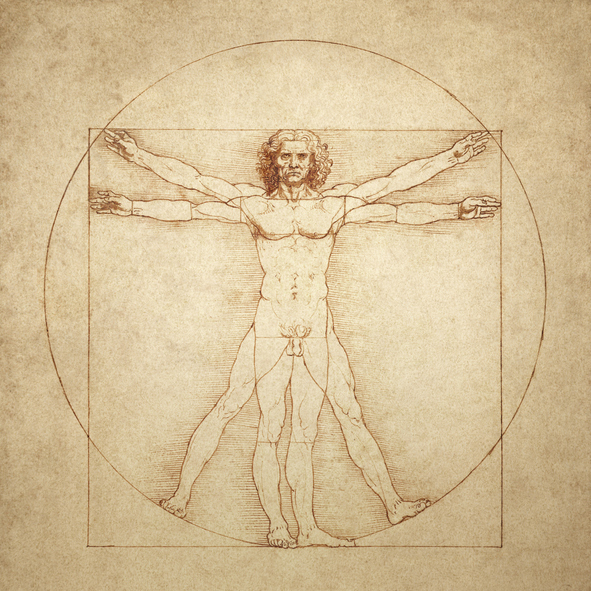
Leonardo da Vinci’s 1490 drawing “Vitruvian Man” could contain a third shape illustrating a dental principle.
In “Vitruvian Man,” da Vinci conveyed the morphologic speculation of a Roman architect Vitruvius, demonstrating that the human proportions can fit within both a circle and square. According to a news article from Popular Mechanics, the third shape was discovered by a dentist practicing in England, who noted that between the legs of the figure depicted in the illustration was what appeared to be an equilateral triangle corresponding to Bonwill’s triangle. William Bonwill, D.D.S., contributed to the optimization of denture development by basing its design on the equilateral triangle he discovered in the human mandible — which connected the contact point of the mandibular incisors with the mandibular condyles.
The dentist who identified the third shape in da Vinci’s illustration explained that the figure’s navel becomes the contact point for Bonwill’s triangle. He detailed that six of these equilateral triangles put together would create a hexagon with a tetrahedral ratio demonstrating geometric relationships observed in optimal synthetic and biological arrangements.
Read more: Popular Mechanics
The article presented here is intended to inform you about the broader media perspective on dentistry, regardless of its alignment with the ADA's stance. It is important to note that publication of an article does not imply the ADA's endorsement, agreement, or promotion of its content.