
Can robotic-assisted tooth autotransplantation minimize bone removal in osteotomy?
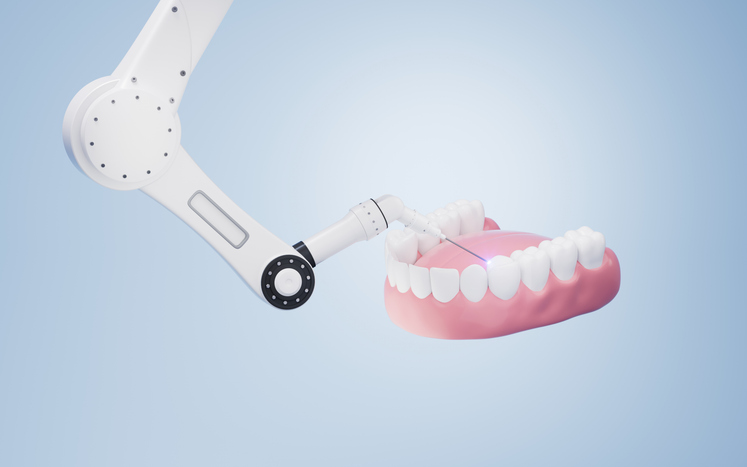
A novel robotic system may help achieve greater osteotomy precision to support tooth autotransplantation.
In an in vitro study published in the International Journal of Oral Science, researchers compared outcomes in geometry-matched socket preparation and surrounding bone preservation between an autonomous, multi-axis robotic system and a static guide-assisted workflow. The autonomous robotic system used a nonlinear, surface-conforming milling trajectory approach, whereas the static guide-assisted workflow used an approach involving guided pilot drilling and subsequent freehand refinement to prepare single- and double-rooted mandibular teeth among 40 3D-printed models.
According to a news article from Oral Health reporting on the findings, the researchers emphasized that the success of tooth autotransplantation hinges on near-matching geometry between the socket and donor roots and minimal damage to the surrounding bone and periodontal ligaments.
Compared with the conventional static guide-assisted workflow, the researchers found that the autonomous robotic system produced fewer deep positional errors, reached greater concordance with the planned preparation outcomes — particularly among double-rooted teeth — and exhibited similar preparation time. They detailed that both apical and angular accuracy were improved with the autonomous robotic system.
The researchers proposed that their novel robotic system could establish conditions that avoid the need for repeated trial insertions, increase transplant stability, enhance periodontal ligament healing and lead to more favorable long-term outcomes. Because of the positive results of the study, they plan to further explore the accuracy of the autonomous robotic system in creating socket fidelity in clinically representative settings.
Read more: Oral Health
The article presented here is intended to inform you about the broader media perspective on dentistry, regardless of its alignment with the ADA's stance. It is important to note that publication of an article does not imply the ADA's endorsement, agreement, or promotion of its content.