ADA governance evaluation enters key synthesis stage
Work bridges initial data collection, development of final recommendations
The American Dental Association’s governance and organizational health evaluation has moved from research and data collection to review and synthesis, according to the fifth monthly update sent by ADA leaders to House of Delegates members.
The evaluation, which was authorized by House Resolution 521H-2025, expands on previous governance studies by examining not only the ADA’s governance structure but also its financial health and sustainability as well as its leadership and management culture and accountability.
Since the evaluation began in April, consulting firm Vista Cova, which was engaged by the ADA to conduct the evaluation, collected input from thousands of stakeholders through surveys, interviews and focus groups. It compiled this research into three preliminary reports, each exploring a specific area outlined in the resolution: governance, financial assessment and sustainability, and accountability and leadership culture.
“It is hard to believe that we are over five months into the governance and organizational health evaluation,” ADA President Richard Rosato, D.M.D., and Executive Director Nader Nadershahi, D.D.S., M.B.A., Ed.D., wrote in the Sept. 1 email. “Although there is still much work to be done, we owe our deep gratitude to thousands of you whose participation and contributions have formed the foundation of this evaluation. Without you, this process would not be possible, and your voices will continue to shape the work ahead.”
The Governance and Organizational Workgroup — the group of 21 ADA representatives and other stakeholders advising Vista Cova — gathered July 29 for a research review and data synthesis session facilitated by the firm. The workgroup reviewed Vista Cova's research methodology and tactics, examined the data collected and initial findings, and began to explore some of the emerging, overarching concepts, including a need for increased transparency, open communication and strategic direction across the ADA.
“The deliberate pacing of the governance evaluation process to capture as many pieces of stakeholder input as possible means that no one voice will be elevated in this process. Instead, Vista Cova, with advisement from the [Governance and Organizational Workgroup], has the opportunity to identify connections across workstreams, build a shared understanding of emerging themes, and ensure that future recommendations are informed by the full breadth of stakeholder perspectives,” Drs. Rosato and Nadershahi wrote. “This work serves as a critical bridge between the initial data collection and research processes and final recommendation development.”
The workgroup’s three subgroups that are aligned with each report topic will continue to meet with Vista Cova to discuss the data and findings.
“These discussions mark an important milestone in Vista Cova's transformation of data into meaningful insights that will inform the next phases of the evaluation,” the ADA leaders wrote.
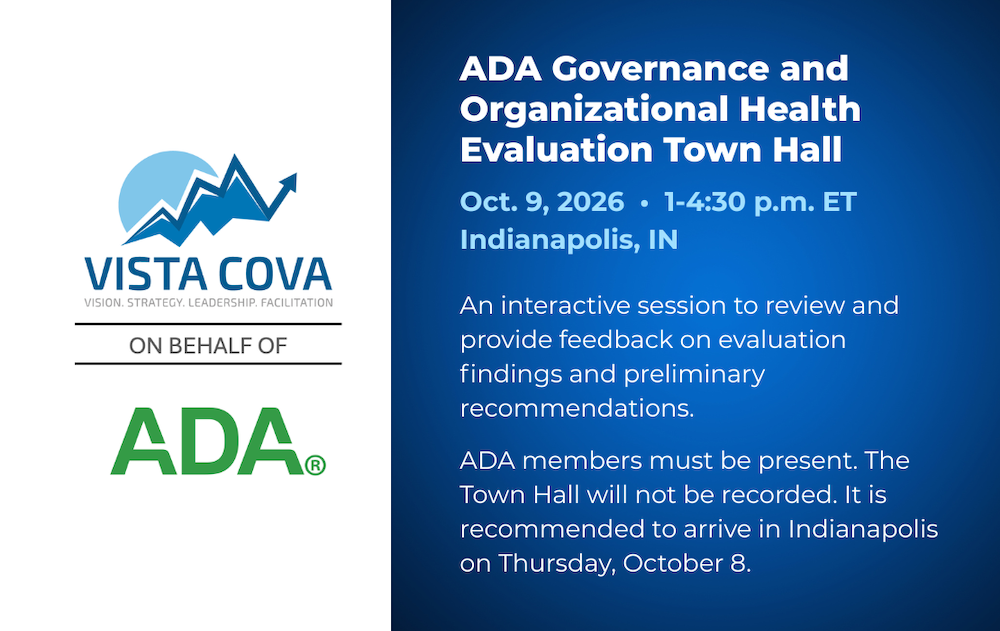
Vista Cova also presented its research reports and initial findings to the ADA Board of Trustees on Aug. 21. It will next facilitate a town hall from 1-4:30 p.m. EDT Oct. 9 in Indianapolis to gather feedback from ADA delegates and alternate delegates, state executive directors, state dental leaders, early career dentists, past ADA leaders and anyone else who is registered to attend the 2026 House. Participants must be present to take part as the event will not be recorded.
Vista Cova, with input from the workgroup, is expected to finalize its recommendations in December. The Board will then consider the recommendations in January 2027.
From February through October 2027, the ADA plans to launch broadscale efforts to communicate the final recommendations. During this time, the Board and executive director may take action on items falling within their respective purviews.
In October 2027, the House will consider a final Board report with proposed resolutions and review Vista Cova’s final report and recommendations.